At some point, you stopped waiting for things to settle. Instead, you found yourself trying to live with the fact that they simply don’t.
You followed the advice. You stayed patient. You told yourself this was part of the process. But as the months go by, that explanation feels less true to what you are actually living.
It starts to feel less like something you need to fix and more like a phase that isn’t clearly named or well understood.
Most of the guidance you get is about arrival. How to get in. How to find work. How to steady yourself. But almost none of it speaks to what comes after.
When a phase is unnamed, people end up carrying it alone and blaming themselves.
Most of the support you are offered is built around arrival.
Language classes. Employment workshops. Settlement guides. Housing confirmation forms.
These are not small things. They matter. But they are all on the outside. They are the things that can be measured, counted, funded.
What they do not reach is what happens after.
The identity that never quite settles. The grief no one mentioned. The years that pass, and the sense that nothing has really landed. The confusion that lingers, even when every checklist is done.
This is not about blaming individual settlement workers. Many are doing remarkable work inside a system that was never built for the long middle.
This is just what I have noticed. The gap you are living in is real. It is not your failure. It is a gap in the system.
What the settlement system was built to count There is a name for what you are in.
Stage 2. The Neutral Zone.
It comes from William Bridges’ research on transitions. He spent decades studying how people move through major life changes, and his most important finding is this: change and transition are not the same thing.
Change is external — the new job, the new country, the new address.
Transition is internal — the psychological shift that happens after the external change is complete.
Stage 2 is the middle. The in-between. The place after the old life is gone and before the new one is fully formed.
It is the most disorienting part of any transition. It is also the part that is least named.
Most newcomers are handed a map at the start. No one gives you a map for the middle.
This series was written from inside the middle.
Stage 2 — The Neutral ZoneThe Series
This is not a guide to help you integrate faster.
It is a guide to what you are actually living, and why it is harder than anyone ever said.
Each issue is four pages. Each one covers a single framework in plain language. The research is there, along with a few questions to keep you company.
It was written by someone who has been in Stage 2 for four years. Not someone who has come out the other side, but someone still inside it.
The research comes from researchers cited by name. I am a translator, not the originator.
My job was to bring their work into words that someone exhausted can actually use at eleven at night, after a long day.
This was written for you if —
You have a job, a SIN number, and a place to live — and you still feel like something is wrong.
You have been in Canada for 2, 3, 4, or 5 years, and you still do not feel like you belong.
You are working below your qualifications, and you feel it in your body every day.
You are performing “fine” for everyone around you while privately struggling.
You are a temporary foreign worker, a PGWP holder, or a precarious worker in Ontario.
You are tired of advice from people who have never lived this.
You have been told to stay positive or be grateful — and it has not helped.
The 10 Issues
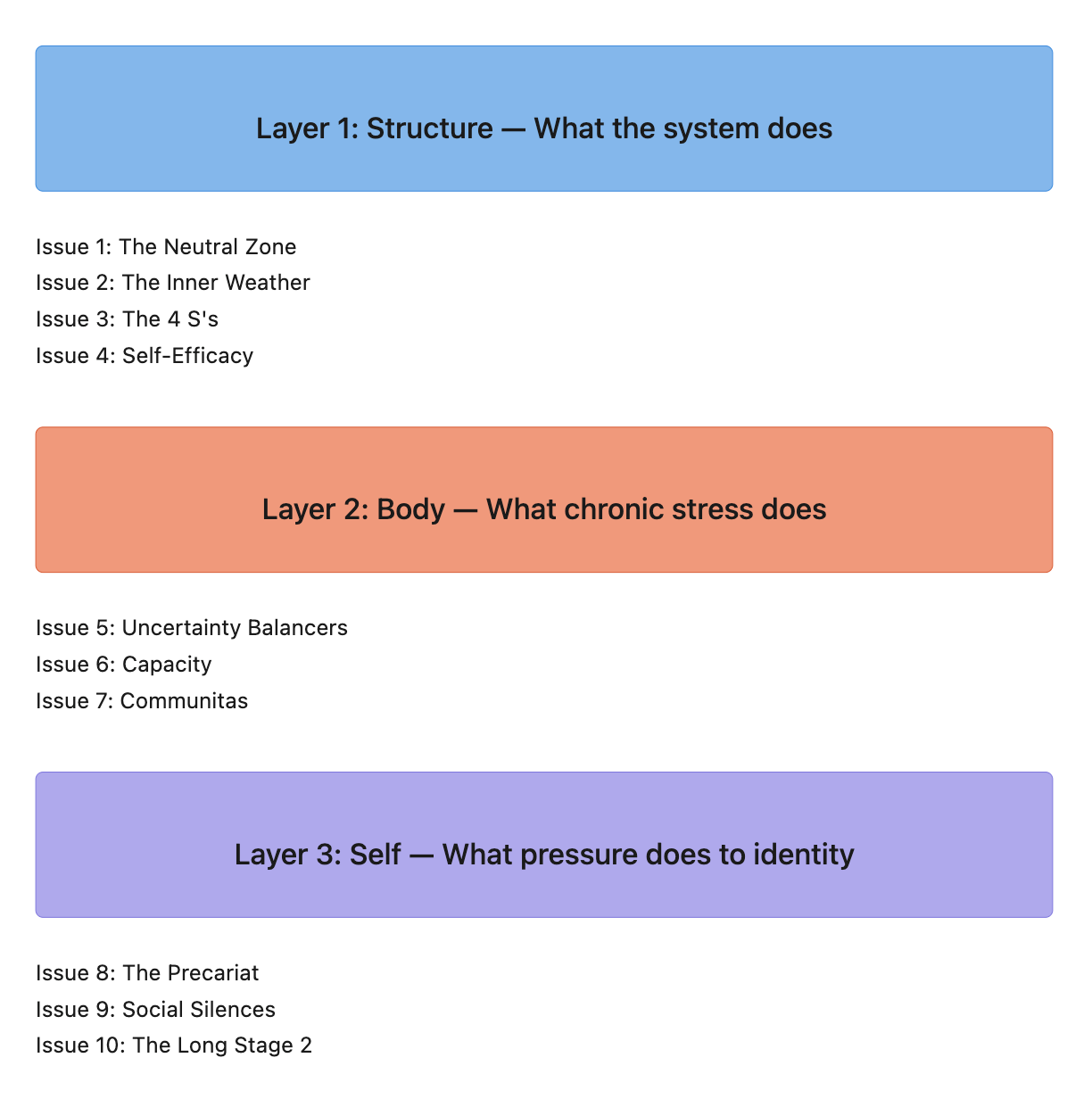
Issue 1 — The Neutral Zone
Where you are. What Stage 2 actually is. And why the map you were given does not cover the middle.
Issue 2 — The Inner Weather
Why your emotions swing so wide — and what the research says about the emotional arc inside Stage 2.
Issue 3 — The 4 S’s
Why two people in the same situation can suffer completely differently. What you are actually working with.
Issue 4 — Self-Efficacy
Why confidence breaks down over time — even when you are doing everything right. And how to rebuild it incrementally.
Layer One - Structure
Issue 5 — Uncertainty Balancers
Why “remember your why” stopped working. What actually steadies you when nothing is certain?
Issue 6 — Capacity
The gap between what you are carrying and what you have capacity for. And why sleep is not the answer.
Issue 7 — Communitas
Why the room matters. Why being around people who understand is not optional — it is neurological repair.
Layer Two - Body
Issue 8 — The Precariat
Why you are not failing at work. Why the system was designed to keep you uncertain.
Issue 9 — Social Silences
Why you notice things others do not say — and what to do with what you observe.
Issue 10 — The Long Stage 2
For people who have been in the middle for years. Why a long transition is not a failed transition. And how to stop blaming yourself for how long it is taking.
Layer Three - Self
It is free. All 10 issues. No catch.
This NTB isn’t a claim, just a way of putting into words what researchers and institutions have already found about what it’s actually like for newcomers and temporary foreign workers in Canada.
If you’ve ever been told you’re making too much of things, overreacting, not tough enough, don’t have the right mindset, that you should have figured it out by now, be strategic, know the ins and outs, the data doesn’t agree.
The NTB issues are where I try to turn this evidence into plain, useful information for Stage 2. This page is where I’ve gathered the research that steadies that work.
Evidence Wall
Hi, I’m Maan Gail Manigsaca (mah-ahn)
I am a Filipino temporary foreign worker in Kingston, Ontario. I have been in Stage 2 for approximately four years.
I clean offices and buildings. That is my job.
I am also the founder of Kingston NetworkBuddy — a peer-led communitas space for newcomers in Stage 2.
I did not write this series from the other side. I wrote it from inside because I needed it to exist, and it did not.
I am not an expert. I am not an authority. I am a person in the middle, paying attention.
And I am grieved — watching people I care about (and myself) receive advice that was never meant for our lives, and then blame ourselves when it does not work.
This series is not a comfort. It is clarity.
It is not advice. It is testimony.
And it is not finished.
I am not trying to solve this.
I am just trying to understand it while I am still inside it.
Most people move through this phase without ever being able to name it.
That is what makes it feel endless.
If this helps you see what you are in a little more clearly, that is enough.
The Evidence Wall
-
Statistics Canada (2022)
Post-migration stressors like social isolation, discrimination, language barriers, and unemployment directly increase mental health risks over time for immigrants, including temporary foreign workers. Anxiety and mood disorders stand out as the strongest risk factors for suicidal ideation in this population.
Source: Statistics Canada, Health Reports, 2022. https://www150.statcan.gc.ca/n1/pub/75-006-x/2022001/article/00012-eng.htmStatistics Canada (2026)
Recent immigrants with mood or anxiety disorders use mental health services at lower rates in Ontario than their Canadian-born counterparts. Both attitudinal barriers (low perceived need) and structural barriers (cost, language, availability) contribute to lower service use.
Source: Statistics Canada, Health Reports, 2026. https://www150.statcan.gc.ca/n1/pub/82-003-x/2026001/article/00001-eng.htmOHCOW — Occupational Health Clinics for Ontario Workers (2022)
International workers in Ontario reported depression, anxiety, and social isolation tied to housing insecurity, job insecurity, and fear of repatriation. Language barriers and a lack of culturally appropriate supports impede access to mental health care, particularly in rural regions.
Source: OHCOW, Mental Health and Psychosocial Supports for International Agricultural Workers, 2022. https://www.ohcow.on.ca/wp-content/uploads/2022/04/mental-health-phsychosocial-supports-for-IAWs_EH_04_2022.pdfNaidoo et al. — Scoping Review (2026)
Migrant workers across Canada face barriers to mental health care, including language, fear of medical repatriation, long work hours, transportation problems, and gaps in coverage — producing elevated rates of depression, anxiety, and unmet mental health needs.
Source: Naidoo et al., scoping review, PMC, 2026. https://pmc.ncbi.nlm.nih.gov/articles/PMC12989624CMHA — State of Mental Health in Canada (2024)
Immigrants and racialized populations in Ontario face uneven access to mental health services driven by income and housing insecurity, and a lack of culturally appropriate programming. CMHA calls for increased funding and culturally tailored services to reduce these disparities.
Source: CMHA, State of Mental Health in Canada, 2024. https://cmha.ca/wp-content/uploads/2024/11/CMHA-State-of-Mental-Health-2024-report.pdfMental Health Commission of Canada — MHCC (2009)
Immigrants, refugees, and racialized groups — including temporary foreign workers — encounter systemic barriers to care: lack of culturally and linguistically appropriate services, and poor service coordination that reduces uptake of mental health supports.
Source: MHCC, Diversity Issues and Options Consultation, 2009. https://www.mentalhealthcommission.ca/wp-content/uploads/drupal/diversity_issues_options_consultation_eng_0_1.pdfTurnbull et al. — Systematic Review (2023)
Filipino workers show high sustained stress linked to family separation, precarious employment, and limited workplace protections — factors directly associated with elevated risk for depression and anxiety, exacerbated by barriers to care in host countries, including Canada.
Source: Turnbull et al., PMC, 2023. https://pmc.ncbi.nlm.nih.gov/articles/PMC9930031 -
IRCC — 2023 Settlement Outcomes Report (2024)
IRCC settlement reporting emphasizes measurable outputs: arrivals, language acquisition, and labour market participation. Emotional well-being, identity reconstruction, and long-term belonging are not core performance metrics in these outcome frameworks.
Source: IRCC, 2023 Settlement Outcomes Report. https://www.canada.ca/en/immigration-refugees-citizenship/corporate/settlement-resettlement-service-provider-information/2023-settlement-outcomes-report.htmlOCASI — Mental Health Promotion Evaluation (2021)
Settlement funding models and reporting requirements incentivize counting outputs (e.g., language classes, employment placements), while mental health and emotional well-being are under-resourced. OCASI recommends embedding mental health supports into core settlement programming and shifting funding to support ongoing interior transitions.
Source: OCASI, Settlement Network Management Evaluation, 2021. https://ocasi.org/sites/default/files/sn-management-evaluation.pdfSRDC — Assessment of IRCC Settlement Service Impacts (2022)
IRCC’s settlement program logic and reporting emphasize short-term, measurable outputs. The assessment identifies limitations in capturing long-term psychosocial outcomes, such as belonging and identity reconstruction, due to program timeframes and funding structures.
Source: SRDC / IRCC, Stage 1 Research Report, 2022. https://srdc.org/wp-content/uploads/2022/07/assessment-of-ircc-settlement-service-impacts-stage-1-research-report.pdfIntegration Outcomes for Forcibly Displaced Persons — Independent Review (2022)
Independent reviews urge metrics to go beyond economic indicators and include quality of life, inclusion, and mental health. Funding models that focus on countable outputs block providers from supporting long-term transitions.
Source: RCUSA / Integration Outcomes Review, 2022. https://rcusa.org/wp-content/uploads/2022/11/Integration-Outcomes-for-Forcibly-Displaced-Persons-FDPs-Final.pdf -
Statistics Canada — Sense of Belonging Analysis (2023)
Immigrants’ sense of belonging grows over the years in Canada, but many racialized newcomers remain “in-between” even after years here. Discrimination and mismatched jobs delay full belonging for 3 to 5 years.
Source: Statistics Canada, Economic and Social Reports, 2023. https://www150.statcan.gc.ca/n1/pub/36-28-0001/2023006/article/00003-eng.htmBerry & Hou — Acculturation Research Applied to Canada (cited in Statistics Canada, 2023)
Research in Canadian contexts shows reaching stable integration and belonging often takes over three to five years, depending on supports and discrimination.
Source: Statistics Canada (citing Berry & Hou), 2023. https://www150.statcan.gc.ca/n1/pub/36-28-0001/2023006/article/00003-eng.htmChoy et al. — Systematic Review on Acculturation and Mental Health (2020) Migrants with low identification with heritage and host cultures have the worst mental health. Acculturative stress can last years, and language barriers, unemployment, and exclusion worsen these ongoing liminal states.
Source: Public Health in Practice, PMC, 2020. https://pmc.ncbi.nlm.nih.gov/articles/PMC9461568 -
Ornek et al. — Systematic Review (2022)
Across quantitative and qualitative studies, precarious employment dimensions — temporariness, vulnerability, disempowerment, low income, lack of rights — are significantly associated with mental health problems, including stress, depression, anxiety, suicidal ideation, and burnout, among migrant workers.
Source: Ornek et al., PMC, 2022. https://pmc.ncbi.nlm.nih.gov/articles/PMC9527784Shankar et al. — Qualitative Study of Recent Immigrants in Precarious Work (2024)
In Canada, 81% of recent immigrants are overqualified for their jobs. They report stress, anxiety, and depression from deskilling, downward mobility, and constant job insecurity—all examples of the “precariat.”
Source: Frontiers in Psychiatry, PMC, 2024. https://pmc.ncbi.nlm.nih.gov/articles/PMC11427846IRCC — Racism and Discrimination Among Migrant Workers (2021)
Systemic racism and discriminatory policy contexts contribute to precarious employment for migrant workers, including TFWs, and are linked to psychological harms: social isolation, identity disruption, and barriers to healthcare and social supports.
Source: IRCC Research Synthesis, 2021. https://www.canada.ca/en/immigration-refugees-citizenship/corporate/reports-statistics/research/racism-discrimination-migrant-workers-canada-evidence-literature.htmlPEPSO / CMHA Ontario — Precarity in Southern Ontario
Large studies show precarious jobs in the GTA and Hamilton mostly affect new and racialized immigrants. These jobs cause poorer mental health, less connection, and less workplace control.
Source: CMHA Ontario (PEPSO summary). https://ontario.cmha.ca/news/precarious-employment-and-well-beingChinchamie — PhD Thesis, University of Toronto (2024)
Detailed qualitative evidence shows deskilling, lost professional identity, and mental health impacts among foreign-educated, racialized immigrant women in Canada—framed as structural racism. These lived experiences connect to precarity and identity disruption.
Source: University of Toronto, Scholaris, 2024. https://utoronto.scholaris.ca/bitstreams/29af8c93-2caa-41bd-b327-c270e23bf422/download -
Rhacel Salazar Parreñas — Filipino Migrant Caregiver Research (2001–2018)
Some studies focus on specific groups (for example, Filipino caregivers) perform heavy emotional labour, keeping public faces of wellbeing while privately enduring hardship. This fragmentation of identity remains invisible in labour statistics and settlement data.
Source: Parreñas, research summary. https://rhacelparrenas.com/wp-content/uploads/2018/11/CVRhacelNov2018NEW.pdf“Invisible Diaspora” — Scoping Review on Migrant Caregivers in Canada (2021)
Migrant caregivers — like Filipinos — face deskilling, social isolation, and countless emotional labour. The review highlights the invisibility of social and emotional labour in policy and service metrics, and notes that community supports are key resilience mechanisms.
Source: International Journal of Health, Technology and Policy (IHTP), Toronto Metropolitan University, 2021. https://journals.library.torontomu.ca/index.php/ihtp/article/view/1419/1400Cognitive Labour / “Third Shift” Study (2025)
Research on the unequal cognitive and emotional labour burden among women in Canada shows newcomers — especially women and caregivers — perform invisible cognitive and emotional tasks that produce exhaustion, reduced career resilience, and hidden mental health impacts not captured in settlement or labour metrics.
Source: Psychology of Women Quarterly, PMC, 2025. https://pmc.ncbi.nlm.nih.gov/articles/PMC12058002 -
Statistics Canada — Social Networks of Immigrant Women (2024)
Immigrant women tend to have smaller social networks — fewer weak ties — than Canadian-born women. Smaller networks constrain opportunities for social integration and increase the risk of isolation, even when basic needs (housing, employment) are met.
Source: Statistics Canada, Economic and Social Reports, 2024. https://www150.statcan.gc.ca/n1/pub/36-28-0001/2024004/article/00006-eng.htmStatistics Canada — Loneliness Among Immigrants (2023)
Approximately 19.2% of older Canadians reported feeling lonely. Immigrant adults — especially those who migrated as adults — were at higher risk than Canadian-born peers, demonstrating that social isolation can persist long after arrival.
Source: Statistics Canada, Health Reports, 2023. https://www150.statcan.gc.ca/n1/pub/82-003-x/2023007/article/00001-eng.htmBarker (2021) — COVID-19 and Newcomer Isolation
COVID-19 exacerbated newcomer social isolation and disrupted access to settlement supports and social ties, increasing vulnerability to mental health problems and extending liminal periods for integration.
Source: Barker, PMC, 2021. https://pmc.ncbi.nlm.nih.gov/articles/PMC8207059Switchboard Technical Assistance — Evidence Summary on Peer Support (2020)
Systematic reviews and settlement evaluations show peer support groups, peer mentorship, and community-led supports improve newcomer mental health by strengthening social ties, increasing resource knowledge, and reducing symptoms of depression and anxiety.
Source: Switchboard TA, Evidence Summary: Impact of Peer Support Groups on Refugees’ Mental Health, 2020. https://www.switchboardta.org/wp-content/uploads/2020/07/Evidence-Summary-Impact-of-Peer-Support-Groups-on-Refugees-Mental-Health.pdfPeel Newcomer Strategy Group — Newcomer Mental Health Report (2023)
Settlement services that integrate culturally relevant mental health supports and peer networks report improved newcomer wellbeing and better linkages to services, underscoring the effectiveness of community-led peer approaches in Ontario settings.
Source: Peel Newcomer Strategy Group, Newcomer Mental Health Report, June 2023. https://peelnewcomer.org/wp-content/uploads/2023/07/PNSG-Newcomer-Mental-Health-Report_June-2023.pdf -
Government of Canada / Agriculture and Agri-Food Canada (2024)
Federal and provincial program notes acknowledge the need to strengthen mental health and psychosocial supports for international agricultural workers in Ontario and nationally, with targeted actions to improve access to rural mental health services and culturally relevant services for TFW populations.
Source: Government of Canada, October 2024. https://www.canada.ca/en/agriculture-agri-food/news/2024/10/governments-strengthening-mental-health-services-for-international-agricultural-workers.htmlOCASI — Pre-Budget Submission (2020)
OCASI documents that precarious immigration status and exclusion from comprehensive settlement entitlements increase barriers to services for Filipino and other TFWs in Ontario. OCASI calls for policy changes to reduce coverage gaps that generate prolonged vulnerability and isolation.
Source: OCASI, Pre-Budget Submission, August 2020. https://ocasi.org/sites/default/files/OCASI_Pre-Budget_Submission_August_2020.pdf
NTB relies solely on research-based evidence, using data from Statistics Canada, IRCC, CMHA, MHCC, OCASI, OHCOW, SRDC, peer-reviewed journals, and Ontario settlement sector reports.
What This Evidence Confirms — In Plain Language
1. The distress is right there in Canada’s own numbers.
Canada’s own long-term survey shows something I can’t ignore: emotional problems among newcomers rise from 5% at six months to almost one in three by year two, and they don’t really drop by year four. This isn’t just a story someone told me. It’s a pattern that keeps repeating.
2. The support system fades just as the need becomes sharpest.
Most of the help for newcomers is packed into those first months after arrival. But the hardest stretch, when mental health distress actually peaks, is around year two, and it lingers for years after. I keep coming back to a McMaster study that found mental health concerns usually show up after the first year or two, right when the official support is already gone.
3. Most newcomers who are struggling never actually get help.
By year two, only about 12% of newcomers who say they’re struggling with emotional problems actually reach out for professional help. It’s not because they don’t need it. The barriers are everywhere: stigma, fear of what it might mean for their immigration status, not seeing themselves in the services offered, and the simple math of survival coming first.
4. Peer support reaches people that formal services miss.
Again and again, reviews show that peer and community-led spaces actually help: they make a difference for mental health, for feeling connected, for finding a way in. Especially for those who are never reached by the official services.
Full citations and links are listed in the Evidence Wall above.
Stay with the work as it unfolds
During the launch of my Newcomer Transition Briefing PDF series, you’ll receive a weekly email with the next issue. After the series is finished, I’ll email occasionally with Kingston NetworkBuddy updates, companion notes, and major releases.
You can unsubscribe anytime.
After you sign up, we’ll send a confirmation email. Please click the confirm link to start receiving emails.